Why a Simple “Gravity Coupling Coefficient” May Not Exist

One of the long-standing questions in physics is whether gravity and electromagnetism are connected through some coupling mechanism. Many researchers have looked for a conversion factor—a coefficient that would tell us how electromagnetic organization translates into gravitational effects.
After studying Barry Setterfield’s Cosmology and the Zero Point Energy, I have come to suspect that this question may be too simple. Not because the underlying idea is necessarily wrong, but because it may begin at the wrong layer of the problem.
The Traditional Picture
In conventional thinking, gravity is understood as mass acting on mass. If that is the case, then it seems reasonable to search for a direct conversion between electromagnetic energy and gravitational effects. This assumption has shaped many attempts to identify a coupling coefficient.
Setterfield’s framework suggests a different structure.
Setterfield’s Proposed Causal Chain
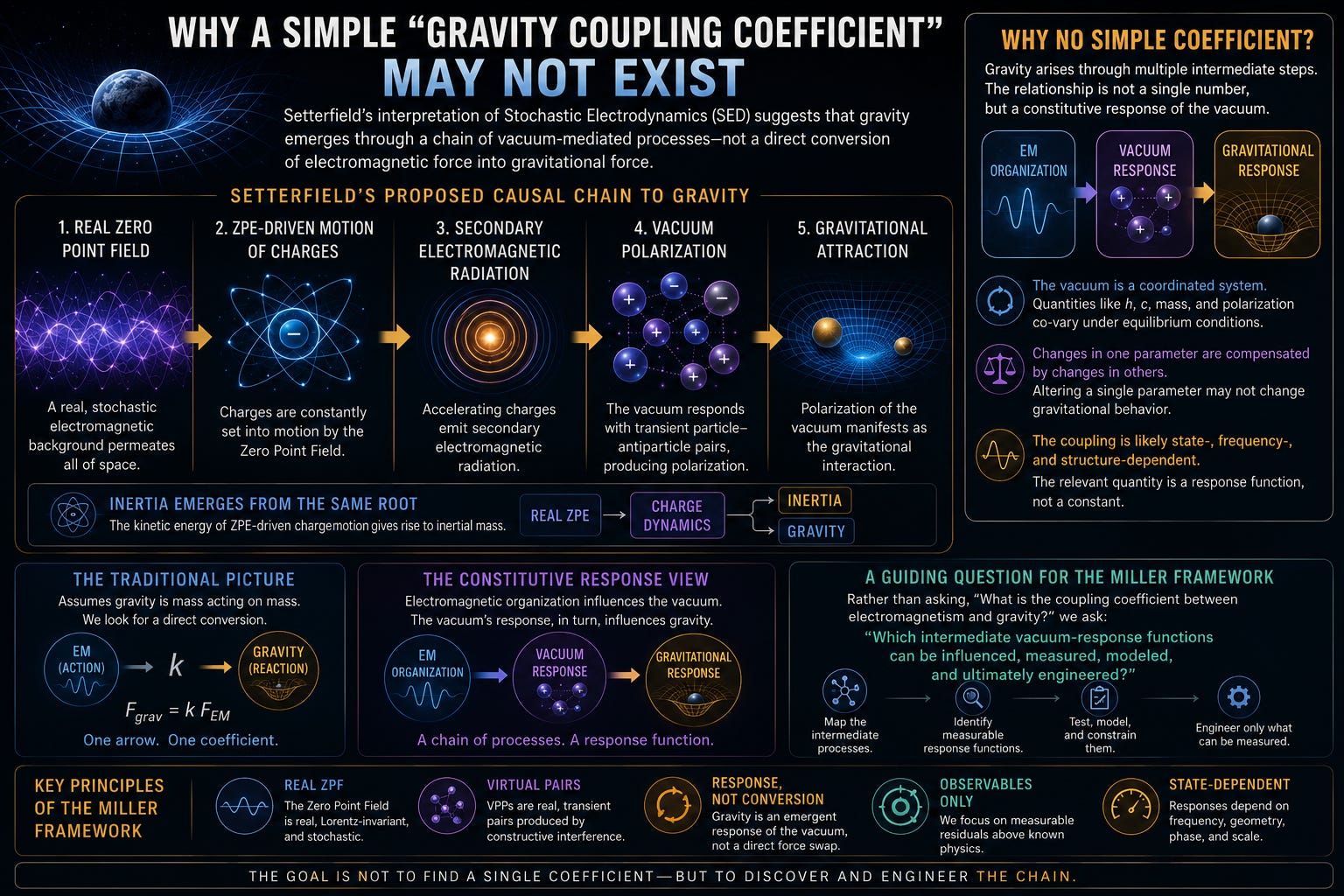
Within Setterfield’s interpretation of Stochastic Electrodynamics, gravity does not arise from a direct interaction between masses. Instead, he proposes the following sequence:
Real Zero Point Field
→ ZPE-driven motion of charges
→ Secondary electromagnetic radiation
→ Vacuum polarization
→ Gravitational attraction
In this view, gravity emerges from the way charged particles continually interact with a real stochastic electromagnetic background.
Within Setterfield’s framework, inertial mass is also treated as an emergent consequence of continual ZPE-driven charge dynamics rather than as a fundamental property. Following the Haisch–Rueda–Puthoff line of reasoning, the inertial mass of particles arises from the kinetic energy associated with this motion.
This creates two parallel branches from the same root:
Inertia emerges from ZPE-driven charge dynamics.
Gravity emerges from the vacuum polarization produced by that same dynamics.
Mass and gravity therefore become sibling consequences of a deeper process rather than one being the direct cause of the other.
Why a Single Coefficient May Not Be Sufficient
If gravity is produced through a chain of intermediate steps—stochastic charge motion, secondary radiation, transient particle–antiparticle pair formation, and the resulting vacuum polarization—then there may not be a simple, direct coupling coefficient between electromagnetism and gravity.
What may exist instead is a constitutive response: a layered process in which electromagnetic organization influences the vacuum’s response, which in turn may influence gravitational behavior.
The quantity of interest may not be a single number, but the structure of that response.
Two Distinct Questions
This distinction matters in practice. We can separate two different lines of inquiry.
1. Can we influence the electromagnetic response of the vacuum?
This includes possible effects on:
vacuum polarization,
effective permittivity,
effective permeability,
dispersion,
and boundary-conditioned participation.
2. Can we influence the vacuum response that gives rise to gravity?
These may represent different response branches of the same underlying vacuum.
Altering the electromagnetic response of the vacuum does not, by itself, imply that its gravitational response has also changed.
Setterfield argues that dimensional quantities such as h, c, particle mass, vacuum polarization, and related electromagnetic properties form a coordinated constitutive system. Under equilibrium conditions, changes in one quantity are accompanied by compensating changes in others.
If that picture is correct, then altering a single parameter in isolation may not produce the gravitational effect one hopes for, because the rest of the system responds as well.
Simply reducing an effective propagation speed, changing a dielectric response, or increasing polarization would therefore not automatically imply stronger gravity.
The full chain would have to be modeled.
A Shift in Approach
This perspective has changed how we think about the work at ZPF Technologies.
Rather than asking: How do we couple electromagnetism to gravity? we have begun asking: Which part of the vacuum response are we actually trying to influence? That question leads to a different research posture.
It directs attention toward the intermediate processes—particularly how organized electromagnetic systems may affect vacuum participation, transient pair response, polarization, phase structure, and dissipation—rather than toward a direct conversion factor.
If this picture is even approximately correct, then the engineering challenge shifts from searching for a single gravity constant to identifying which intermediate response functions can be influenced, measured, and ultimately modeled.
From a Single Arrow to a Constitutive Chain
Many gravity-control discussions implicitly assume something like:
where k is an unknown coupling coefficient. Setterfield’s framework suggests a more complicated structure:
Electromagnetic Organization —> Vacuum Response —> Observable Gravitational Response.
There is no longer a single arrow from electromagnetism to gravity. There is an entire constitutive chain. That may be why the coupling coefficient has proven so difficult to identify. The missing object may not be a constant at all. It may be a frequency-dependent, state-dependent, and possibly nonequilibrium response function.
Looking Forward
Whether Setterfield’s proposed mechanism ultimately proves correct remains an open question. It represents one interpretation within Stochastic Electrodynamics and differs substantially from the current mainstream understanding of gravity.
Even so, it highlights a useful possibility.
The most productive path forward may not be to search for a single coefficient that converts electromagnetism into gravity. It may be to map the intermediate physical processes that would have to occur before an organized electromagnetic system could influence anything we would recognize as a gravitational response.
That is the direction we are now exploring at ZPF Technologies.
From Constants to Response Functions
One implication of this perspective is that we may be searching for the wrong kind of mathematical object.
For decades, many discussions about gravity have implicitly assumed that the relationship between electromagnetism and gravity, if it exists, should look something like:
F₍grav₎ = kF₍EM₎
where k is some unknown coupling coefficient.
But if Setterfield’s proposed causal chain is even approximately correct, then that relationship may be far too simple.
Rather than a single conversion factor, the vacuum may exhibit a layered constitutive response. Organized electromagnetic systems may first influence the vacuum’s internal state—its participation, polarization, and collective response—and only then, under the appropriate conditions, produce any measurable gravitational effect.
In that case, the quantity we seek is not a universal constant but a family of response functions describing how one stage of the process influences the next.
This has become one of the guiding ideas behind our own research.
Instead of asking,
“What is the coupling coefficient between electromagnetism and gravity?”
we have begun asking,
“What are the intermediate response functions that connect organized electromagnetic systems to the vacuum, and under what conditions do they become significant?”
That may seem like a subtle distinction, but it fundamentally changes the engineering challenge.
Rather than searching for a single “gravity coefficient,” the goal becomes identifying, measuring, and ultimately modeling the individual response pathways that connect organized electromagnetic systems to the observable behavior of the vacuum.
If such pathways exist, they will likely reveal themselves one response function at a time—not as a single magical constant.